
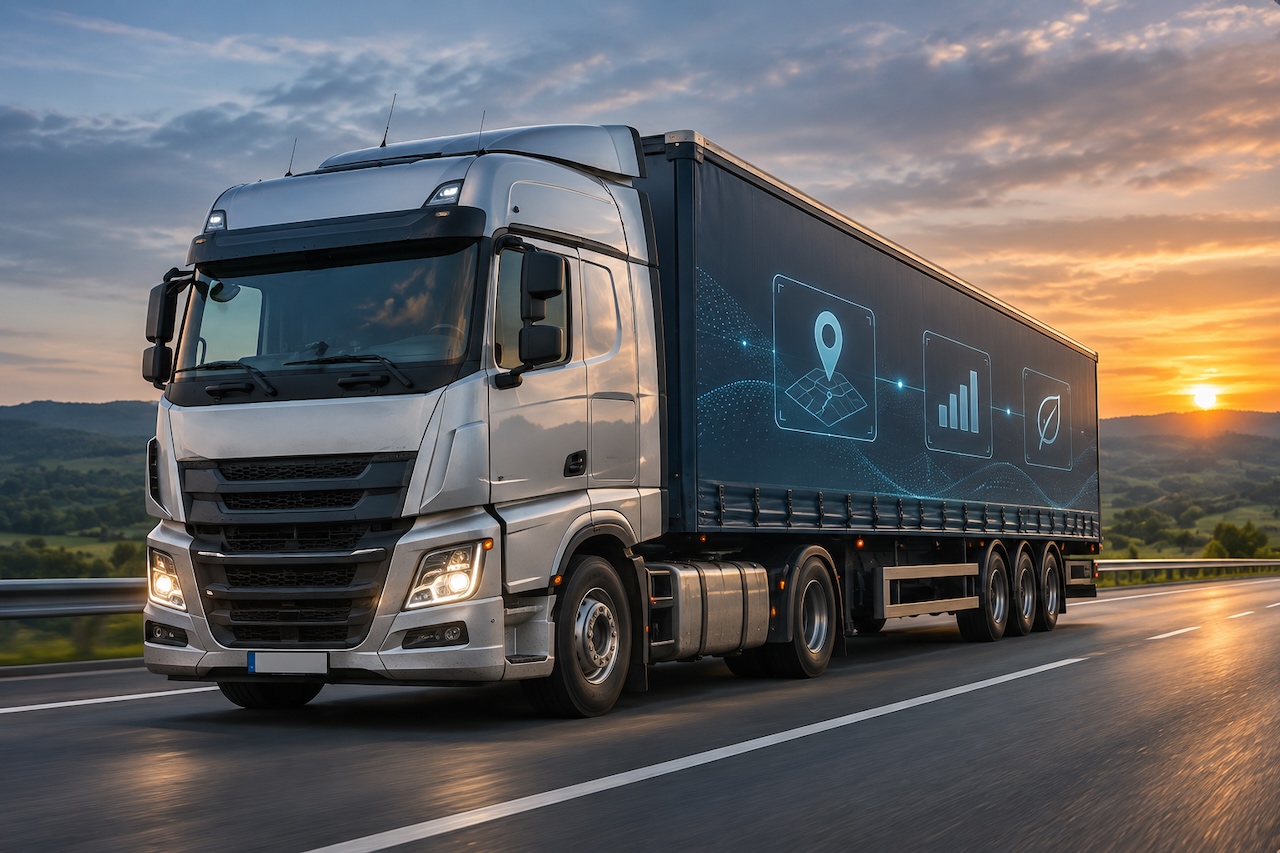
Managing a transport fleet has never been a simple exercise in moving vehicles from one location to another. Operators must coordinate drivers, maintenance, deliveries, fuel or charging, customer expectations and constantly changing road conditions. Even a small disruption can cascade across a tightly scheduled operation.
Artificial intelligence (AI) is creating new ways to support these decisions. By analysing vehicle diagnostics, location data, maintenance records and external information, AI-enabled systems can identify patterns that would be difficult to spot manually. The goal is not necessarily to replace dispatchers or fleet managers, but to give them better information at the moment it matters.
The opportunity is significant—but so is the gap between a promising algorithm and a system that consistently delivers value in day-to-day transport operations.
From connected vehicles to intelligent fleets
Telematics has already changed the information available to fleet operators. Modern systems can collect GPS positions, mileage, engine hours, fault codes, idling time, fuel use and, for electric vehicles, charging and battery-related information. According to the US Department of Energy's fleet telematics guidance, these data can support maintenance, vehicle utilisation analysis, safety and operational planning.
Traditional fleet software often presents this information in dashboards or alerts. AI adds another layer: it can examine multiple signals together, detect unusual behaviour and suggest actions based on historical patterns.
For example, a fleet manager might see a vehicle's fault code in a dashboard. An AI-assisted system could also consider the vehicle's age, duty cycle, repair history and recent sensor readings to flag a developing problem or recommend an inspection. This is a shift from merely seeing what is happening to estimating what may happen next.
The distinction matters. More data does not automatically make a fleet more efficient. Value emerges when information is translated into practical decisions that drivers, technicians and dispatchers can use.
Predictive maintenance: addressing problems before breakdowns
One of the clearest applications of AI in fleet operations is predictive maintenance. Conventional preventive maintenance generally follows a schedule based on time, mileage or engine hours. Predictive approaches look for evidence that a particular component may need attention earlier—or that a routine intervention can safely wait.
Machine-learning models can analyse changing temperature, vibration, pressure, diagnostic trouble codes or other operating signals alongside maintenance history. They may identify anomalies associated with component degradation and help maintenance teams prioritise inspections.
Consider a long-haul truck that is repeatedly showing unusual cooling-system readings. Rather than waiting for a more serious fault, a maintenance team could review an alert, inspect the vehicle at a suitable stop and determine whether a repair is necessary. Avoiding a roadside failure can also prevent missed delivery windows, recovery costs and unexpected changes to driver schedules.
There are important limits. A predictive model can miss faults, generate false alarms or learn misleading patterns from incomplete records. Rare failures are particularly difficult to model because there may be too few examples for reliable training. Predictions therefore need to complement—not replace—manufacturer guidance, established maintenance procedures and professional judgement.
The most useful question for operators is not whether a platform claims to use AI, but whether it can demonstrate fewer avoidable failures and better maintenance planning under real operating conditions.
Route optimisation that responds to reality
Fleet routing is more complicated than finding the shortest distance between two points. Dispatchers may need to consider delivery windows, vehicle capacity, driver hours, road restrictions, traffic, weather, customer priorities and available loading facilities.
AI-assisted routing tools can help analyse these interacting constraints and update plans as conditions change. A system might identify a more practical sequence of deliveries, suggest a route around a disruption or flag that a particular assignment is unlikely to meet its scheduled arrival time.
The objective should be operationally feasible routes, not simply shorter lines on a map. A route that saves distance but causes a missed delivery slot or violates a vehicle restriction is not an improvement.
Human dispatchers remain essential. Customers may change their requirements, drivers may report conditions that are not visible in the data, and an algorithm may not understand a site's informal unloading rules. A sensible implementation allows people to override recommendations and record why they did so, helping teams evaluate and improve the system over time.
Fuel efficiency, energy use and sustainability
Energy costs are a major operational consideration for transport fleets. AI can support efficiency programmes by identifying avoidable idling, inefficient route patterns, unusual fuel consumption and differences between planned and actual vehicle use.
For conventional vehicles, the relevant decisions may involve trip planning, driver coaching, vehicle assignment and preventive maintenance. For electric fleets, optimisation also has to account for battery state of charge, charger availability, charging duration, route suitability and the operational cost of taking a vehicle out of service.
These factors are interconnected. A theoretically efficient route may not be suitable for an electric truck if charging infrastructure is unreliable or if the schedule does not allow sufficient charging time.
Operators should therefore evaluate energy performance at the fleet level rather than judging isolated recommendations. Useful measures can include energy or fuel use per kilometre, per delivery or per tonne-kilometre, alongside service reliability. Improvements depend on vehicle type, workload, geography and implementation quality; they should not be assumed in advance.
Better visibility for dispatchers and managers
AI can also help fleet teams manage the flow of information. Instead of asking staff to monitor dozens of dashboards continuously, software can prioritise exceptions that may need attention: a delayed vehicle, an unexpected stop, a rising maintenance risk or a delivery whose estimated arrival time has changed materially.
This can make operational oversight more proactive, provided alerts are accurate and actionable. Too many low-quality notifications create alert fatigue; too little context makes it difficult to decide what to do.
Good systems should explain the basis for a recommendation in operational terms: which vehicle is affected, which constraint has changed, what action is suggested and what happens if the recommendation is ignored.
AI-generated summaries may help with shift handovers and reporting, but important decisions—especially those affecting safety, compliance or customer commitments—still require verification by responsible personnel.
Data quality is the foundation
The practical challenge is often less about choosing an AI model than about preparing the information it relies on. Fleets may operate vehicles from different manufacturers, use separate maintenance and dispatch systems, and store records in inconsistent formats.
Common obstacles include missing sensor data, incorrect vehicle identifiers, incomplete repair histories, unreliable timestamps and poor integration between telematics and transport management systems.
A model trained on weak data may produce confident but unhelpful outputs. Before investing in advanced analytics, operators should assess data completeness, define consistent maintenance codes, connect critical systems and establish who is responsible for data quality.
Integration is just as important as prediction. An alert has little value if it cannot reach the technician, dispatcher or fleet manager who can act on it.
Safety, privacy and cybersecurity cannot be afterthoughts
Connected fleets generate information about vehicles, routes and potentially identifiable drivers. This creates responsibilities around access, retention, security and lawful processing of personal data.
Operators should be clear about what they collect, why they collect it, who can see it and how long it is retained. They should also review vendor contracts, security controls and the ability to export or delete data. In Europe, relevant data-protection and vehicle-data rules may apply depending on the use case.
AI should be introduced especially carefully where recommendations influence safety-critical decisions. A dispatch suggestion and a system that directly controls a vehicle are not the same kind of application and should not be treated as having equivalent risk.
Cybersecurity also matters: compromised telematics accounts or poorly secured integrations can expose sensitive operational information. Access controls, audit logs, software updates and incident-response procedures are part of a trustworthy deployment—not optional extras.
How fleet operators can start with AI
A practical rollout begins with a specific operational problem rather than a broad ambition to “become AI-driven.” A transport company considering AI should work through a manageable sequence:
- Choose one use case. Start with a problem such as unexpected maintenance events, frequent delivery delays or excessive idling.
- Measure the baseline. Record current downtime, on-time performance, maintenance expense or energy use before introducing a new tool.
- Check the data. Confirm that the necessary information is accurate, timely and accessible.
- Run a limited pilot. Test the system on a representative group of vehicles or routes, ideally against a comparable baseline.
- Keep people involved. Give dispatchers, technicians and drivers a way to review, challenge and improve recommendations.
- Evaluate total value. Include software fees, integration, training, additional workload and error costs—not just promised savings.
- Scale selectively. Expand only when the benefits are demonstrated and the workflow is reliable.
This approach helps distinguish useful operational intelligence from attractive dashboards that do not change outcomes.
The future: from reactive decisions to coordinated operations
Fleet management is moving toward greater coordination among vehicles, depots, maintenance teams, dispatch systems and customers. As data integration improves, AI could help operators make decisions across these functions rather than optimising each in isolation.
A maintenance forecast, for instance, might influence vehicle assignment. An anticipated delivery delay could trigger a revised dispatch plan. Changes in energy prices or charging availability could affect how an electric fleet schedules its next day of work.
Yet the ambition should remain realistic. Transport operations unfold in the physical world, where data can be incomplete, infrastructure can fail and unexpected events are normal. AI is most credible when it improves human decisions and is evaluated against measurable operational results.
For fleet operators, the competitive advantage will not come from adopting AI for its own sake. It will come from combining reliable data, experienced people and well-designed processes to run safer, more dependable and more efficient transport operations.