
Global trade has proved more resilient in 2026 than many forecasters expected. Yet the companies moving those goods are not necessarily enjoying a corresponding improvement in their finances. Across road haulage, container shipping, air cargo and rail freight, rising costs, disrupted routes and uneven demand are producing sharply different market conditions.
The distinction matters. A higher freight rate can reflect a shortage of capacity or stronger customer demand. But it can also be the price of more expensive diesel, a longer journey or a delayed shipment. For transport companies, the difference determines whether revenue growth translates into sustainable margins.
The central question for transport businesses heading into 2027 is not simply whether freight rates are rising. It is whether those rates cover the real cost of delivering a reliable service.
Global trade is holding up, but the recovery is uneven
In its October 2026 trade outlook, the World Trade Organization raised its projection for merchandise trade volume growth this year to 3.9%, from the 1.9% forecast in March. It expects a further 4.1% increase in 2027. The revision was substantial, particularly given the disruption to energy supplies and transport routes associated with the Middle East conflict.
But the headline obscures an important shift in what is being traded. The WTO attributes much of the stronger performance to investment in artificial intelligence infrastructure and the movement of related goods. Demand for components and equipment used in data centres and other AI systems is helping sustain trade even as energy and fertilizer markets face disruption.
That is not the same as a broad-based rebound in every transport segment. A shipment of high-value electronics may support air cargo or a specific container corridor, while bulk commodities and regional road freight respond to quite different forces. Trade growth can be concentrated in particular products, origins and destinations rather than distributed evenly across carriers.
There is also a distinction between the volume of goods crossing borders and the profitability of the businesses handling them. The WTO cut its forecast for commercial services trade growth in 2026 to 3.3%, from 4.8%, reflecting pressure on services including transport and travel. The two forecasts are not contradictory: physical trade can expand while the economics of providing transport services deteriorate.
European road freight: record rates, weaker volumes
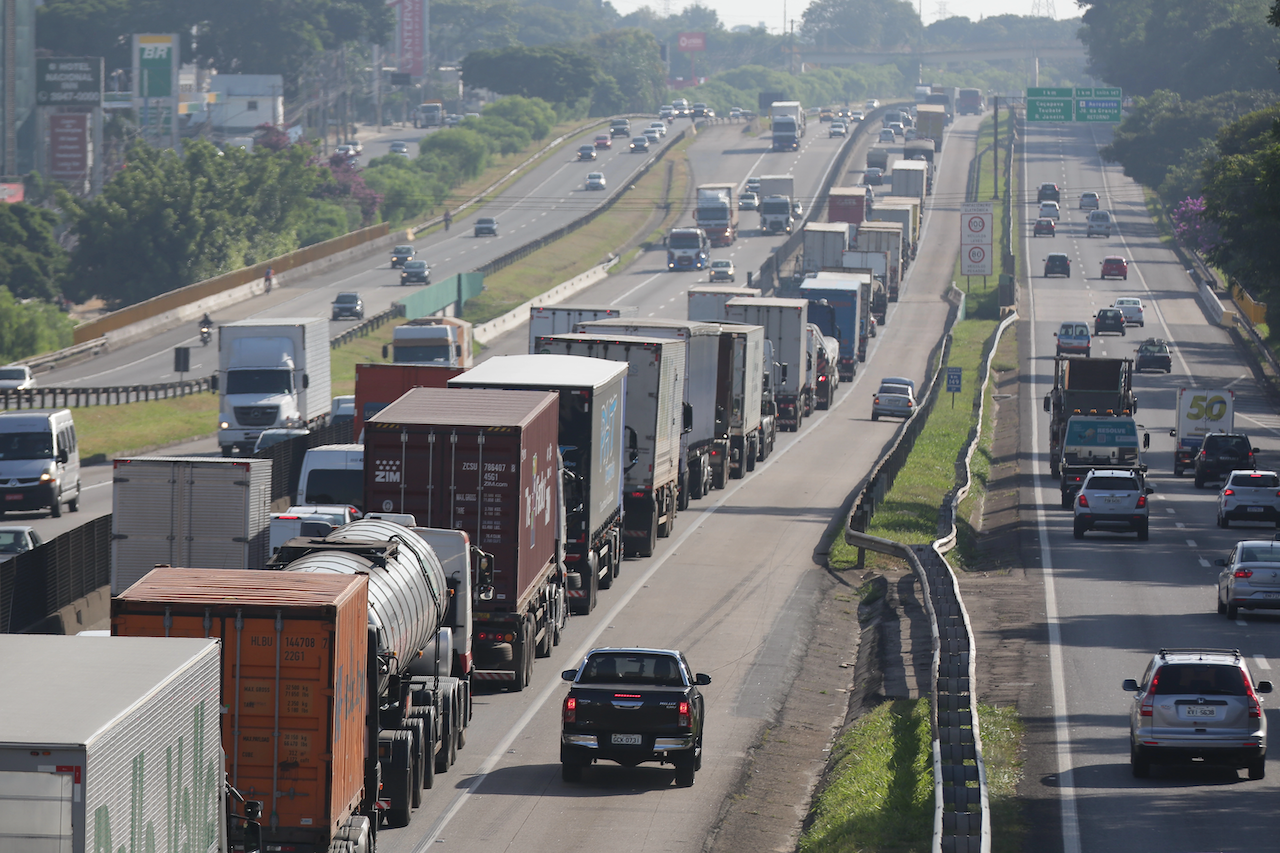
The clearest example of that divergence is European road haulage. According to the Upply, Transport Intelligence and IRU benchmark published on 10 November, the European contract freight rate index reached 148.9 in the third quarter of 2026, while the spot index stood at 147.6. Both were at record levels for the series.
Ordinarily, record prices might suggest a strong market. In this case, the evidence points elsewhere. The report found that road trade volumes on major corridors between EU economies fell 4.5% quarter on quarter. Meanwhile, the EU's weighted average diesel price was EUR 2.05 per litre during the quarter, up 32% from a year earlier, and peaked at EUR 2.27 in late September.
The rate increase, in other words, was driven largely by the need to pass higher costs through to customers. The benchmark's underlying data also showed the French long-haul truck cost index rising sharply year on year, but much less once diesel was excluded. An operator charging more per kilometre may still be struggling to recover its operating expenses.
This creates a difficult negotiating environment. Shippers want to avoid paying crisis-driven rates indefinitely; carriers cannot absorb unpredictable fuel and toll increases without jeopardising financial stability. Short-term spot prices and longer-term contract prices respond differently to these pressures, particularly when contracts contain fuel-adjustment mechanisms.
National markets are also moving at different speeds. Germany has experienced particularly sharp increases in some domestic rates, while other corridors show weaker demand and less pricing power. The European benchmark is therefore useful as a market signal, but a poor substitute for lane-by-lane analysis.
For a road carrier, the operational questions are increasingly specific: Can it secure return loads? How quickly are fuel surcharges adjusted? What share of a contract is exposed to toll changes? Does the customer pay for waiting time? Those details often matter more than the headline freight index.
Container shipping: falling spot rates do not mean stability
Ocean freight presents a different combination of pressures. Drewry's World Container Index fell to USD 4,305 per 40-foot container on 12 November 2026, a 2% weekly decline, according to its weekly market assessment. Rates on several major East–West routes declined as available capacity increased and demand softened.
But a falling composite index does not mean transport conditions have returned to normal. Container pricing depends on the route, the balance of equipment and vessels, service reliability, congestion and the carrier's ability to withdraw capacity. The index is a benchmark for selected spot markets, not the price paid by every shipper under every contract.
Carriers can respond to weaker demand through blank sailings — cancelling scheduled departures to reduce available capacity. Such measures may help support rates, but they can also complicate planning for cargo owners. A shipper offered a lower quotation may face a longer wait, an inconvenient transshipment or less flexibility if the sailing changes.
The return of some traffic to shorter routes can also free up vessel capacity, placing further pressure on rates. Yet geopolitical risks and shifting traffic patterns make it difficult to predict how durable those changes will be. Freight buyers therefore need to evaluate transit-time reliability and contingency arrangements alongside price.
For carriers and forwarders, this is a market in which capacity management remains essential. For importers and exporters, it is an argument against treating the cheapest quoted rate as the full cost of a shipment.
Air cargo: demand is strong, fuel is stronger
Air freight has been one of the more dynamic segments of the transport market. The International Air Transport Association reported that global cargo demand, measured in cargo tonne-kilometres, rose 7.7% year on year in September 2026. Available cargo capacity increased by a more modest 2.7%.
The overall figure was positive, but performance varied widely. North American carriers recorded particularly strong growth, while routes connected to the Middle East remained under pressure. IATA also identified strong demand linked to AI-related shipments, including on trans-Pacific routes.
For airlines, however, carrying more freight does not automatically mean making more money. IATA reported that jet fuel prices in September were 103.4% higher than a year earlier. Increases of that magnitude alter the economics of cargo capacity, particularly when customers cannot absorb a comparable rise in freight charges.
The result is another apparent contradiction: demand can expand while margins come under strain. An airline must consider whether additional cargo revenue justifies the fuel, handling and operational costs of the capacity used to carry it. Forwarders face similar questions when volatile rates meet contractual commitments to customers.
Air cargo will remain important for time-sensitive, high-value and disruption-sensitive shipments. But its growing share of some trade lanes should not be mistaken for an industry-wide escape from the economics of energy and capacity.
Rail freight: structural potential, disappointing volumes
Rail is frequently discussed as an answer to road congestion, emissions and long-distance freight capacity constraints. Yet the latest complete annual European figures show that shifting substantial volumes to rail remains difficult.
Eurostat reported in September 2026 that EU rail freight activity fell 1.8% in 2025, to 368.2 billion tonne-kilometres. It was the fourth consecutive annual decline. Germany accounted for about one third of EU rail freight performance, underlining the concentration of the market in a relatively small number of national systems and major corridors.
These are 2025 results, not a measurement of the entire 2026 market. They nevertheless illustrate the structural challenge facing rail operators. Expanding the role of rail requires more than an attractive price per tonne-kilometre. Freight customers also need dependable paths through rail networks, suitable terminals, usable timetables and effective connections at both ends of the journey.
There is a commercial tension here. Rail's environmental and capacity advantages are most convincing when trains run with high utilisation over suitable distances. But customers often value short lead times and flexibility, especially when distribution networks are changing. Intermodal services must compete on the total door-to-door proposition rather than the rail segment alone.
For investors and policymakers, the decisive indicators may therefore be terminal productivity, punctuality, network availability and the ease of cross-border operations — not simply announcements of new infrastructure.
Investment decisions are becoming more selective
Transport companies are also making capital decisions in an uncertain environment. Vehicle replacement, alternative-fuel equipment, digital systems and new warehousing or terminal capacity all compete for limited budgets. Rising financing and energy costs can make an otherwise sensible investment harder to justify.
European vehicle registration data offer one useful, if imperfect, signal. The European Automobile Manufacturers' Association reported that EU truck registrations increased 7.5% in the first nine months of 2026, recovering from a relatively low base. Van registrations were broadly flat. New registrations indicate purchasing activity, however, not necessarily an equivalent increase in freight capacity: vehicles may replace older fleets rather than expand them.
Digital investments also deserve scrutiny. Route-planning tools, predictive maintenance, real-time visibility and automated documentation can help reduce wasted time and improve decisions. They cannot eliminate fuel-price shocks, create missing drivers or guarantee that a customer will pay a profitable rate.
The most useful projects address a measurable operational problem: fewer empty kilometres, faster turnaround, reduced downtime or better on-time performance. Technology can improve resilience, but it should be assessed against observable changes in cost and service quality rather than broad promises of transformation.
What transport businesses should watch in 2027
The next market phase will depend on developments that do not move together. Several indicators deserve particular attention:
- Demand by trade lane and commodity. Growth concentrated in AI-related equipment is not the same as stronger demand across consumer goods, industrial freight and bulk cargo.
- Fuel and other operating costs. Freight rates must be compared with diesel, jet fuel, tolls, labour and financing costs before conclusions are drawn about profitability.
- Effective capacity. New vehicle registrations, vessel availability, cancelled sailings and network restrictions all affect what operators can actually offer customers.
- Service reliability. Missed departures, port waiting times, empty running and delayed handovers can turn a low nominal transport rate into an expensive logistics outcome.
- Contract structure. The speed with which fuel or congestion costs can be passed through matters for both carrier margins and shipper budgets.
No single indicator can settle whether the transport market is improving. Rates may fall for healthy reasons, such as better productivity and greater capacity, or unhealthy ones, such as collapsing demand. They may rise because customers need more transport — or because the same transport has become much more expensive to provide.
A market that rewards precision, not optimism
The evidence available in November 2026 points neither to a uniform freight boom nor to a universal downturn. World merchandise trade is expanding faster than expected. European road freight prices are high despite weaker activity on important corridors. Container spot rates are easing but remain vulnerable to capacity and route disruptions. Air cargo volumes are growing while fuel costs challenge profitability. European rail continues to face structural obstacles to growth.
For transport businesses, the common lesson is the need to separate volume, pricing, operating cost and reliability. These measures are connected, but they are not interchangeable.
That distinction should shape the coming round of investment and contract decisions. In an uneven market, success may depend less on correctly predicting the direction of a global freight index than on understanding the economics of each route, service and customer.
Further Reading
- World Trade Organization — Global Trade Outlook and Statistics, October 2026 update
- IRU, Upply and Transport Intelligence — European road freight rates, Q3 2026
- Drewry — World Container Index, weekly market assessment
- IATA — Air cargo demand, September 2026
- Eurostat — EU rail freight transport in 2025
- Eurostat — EU road freight transport in 2025
- ACEA — EU commercial vehicle registrations, January–September 2026